

MBNMS Enforcement Program
 |
| Sanctuary enforcement personnel work by land, by sea and by air. |
Report An Incident or Violation
Every day, people see things in the sanctuary that concern them, such as sick and injured animals, spills, construction, low-flying aircraft, wildlife disturbance, and more. Information on how to report such sightings and who to call is available on our Enforcement Contact page.
Mission and Enforcement Philosophy
The Monterey Bay National Marine Sanctuary (MBNMS) enforces fourteen federal regulatory prohibitions designed to preserve and protect the natural and cultural resources and qualities of the ocean and estuarine areas within its boundaries. Prohibitions restrict seabed disturbance, discharges, wildlife harassment, and disturbance of historical resources. Due to the nature of these prohibitions, violations often produce damage or injury that cannot be easily or readily remediated. The MBNMS enforcement philosophy is therefore based on preventive enforcement, with a strong emphasis on public outreach and education.
Personnel and Equipment
Primary law enforcement responsibilities for the MBNMS rest with the Office of Law Enforcement (OLE) for the National Oceanic and Atmospheric Administration (NOAA). Federal Officers and Special Agents, stationed in Monterey, conduct investigations into violations of the National Marine Sanctuaries Act and regulatory prohibitions in coordination with State, local and other Federal law enforcement counterparts. They also conduct land/air/sea patrols and address recurring enforcement problems through Community Oriented Policing and Problem Solving (COPPS) techniques, which emphasize involving the community to resolve problems.
In 1998, a cooperative enforcement agreement was signed between NOAA and the State of California to authorize the deputization of State Fish and Game Wardens and State Park Rangers as Federal Sanctuary enforcement officers. These State peace officers work together with OLE to conduct patrols and investigate potential violations within the MBNMS. Wardens patrol the Sanctuary using small boats and large patrol vessels. They also conduct coastal patrols by land and air. State Park Rangers in the Big Sur and Cambria regions conduct coastal patrols and investigations, and monitor the Northern Elephant Seal breeding/pupping area at Piedras Blancas.
In addition to the cooperative assistance by the State, the U.S. Coast Guard conducts air and sea surveillance within the MBNMS and has broad Federal enforcement authority within the Sanctuary. OLE Officers and Special Agents also work with other Federal enforcement agents from the U.S. Fish and Wildlife Service, the U.S. Environmental Protection Agency, and the Federal Bureau of Investigations (FBI) to investigate violations of environmental laws within the Sanctuary.
Penalties
Violation of Sanctuary regulations is punishable by civil penalties of up to $140,000 per day of violation. In addition to fines, violators may also be required to pay for emergency response, environmental damage, and remediation costs. Any property involved in a violation (e.g. boats, equipment, tools) may be seized and held by enforcement officials, pending legal action. In many cases, violation of Sanctuary regulations also involve violation of other Federal and State laws and carries the potential for additional fines, property seizures, detainment, and criminal prosecution. Interference with a Sanctuary enforcement investigation or officer is a criminal offense.
Profile of Violations
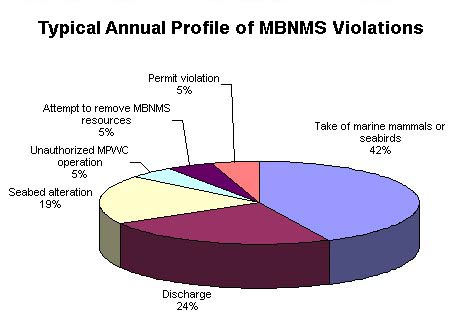
Most individual violations tend to be confined to small areas for short time durations. However, some types of violations occur frequently throughout the Sanctuary, such as marine mammal/bird harassment and marine discharges. The vast majority of recorded violations are detected within 10 miles of shore due to the large concentration of human activities near the coastline. Disturbance of marine mammals and seabirds is the most common reported violation, followed by discharges, seabed alteration, and unauthorized MPWC operation. The chart below displays the type and relative percentage of Sanctuary violations in a typical year:
Voluntary Compliance Programs
Visitors to the Sanctuary may not realize that pulling an invertebrate from a rock or approaching too close to a seal can result in serious consequences for the animal, and sometimes the visitor as well. When such seemingly minor disturbances are multiplied by the hundreds of thousands of visitors to the Sanctuary each year, the effects to the ecosystem can be chronic, leading to a slow decline in the health of wildlife and habitats. To address such issues, the Sanctuary Enforcement Team applies Community Oriented Policing and Problem Solving (COPPS) techniques, developing programs to inform the public and enlist their help in protecting the Sanctuary ecosystem. The MBNMS inaugurated Team Ocean in 2000, a program that sends interpreters to sea in kayaks to speak to summer boaters in the nearshore areas of Monterey and Elkhorn Slough. The interpreters explain the best ways to approach and view wildlife without frightening the animals away. Each time an animal is forced to dive or swim away, it must stop feeding or resting and burns precious energy reserves during evasion. Repeated disturbance by successive visitors can stress an animal to the point that it becomes fatigued and susceptible to illness and disease. Team Ocean interpreters share these facts with visitors, giving them a better appreciation and concern for the animals and habitats they have come to see. The Sanctuary Enforcement Team has also worked successfully with volunteers and other agencies to reduce escalating elephant seal disturbance near Piedras Blancas. Volunteers staff a docent field program to provide for organized visitation of the elephant seal rookeries, while Federal and State officials assure that willful disturbance of the animals is corrected.
Eyes on the Coast
The Sanctuary develops and promotes many educational programs to inform the public about activities that can harm the marine environment and Sanctuary resources. The Sanctuary strongly encourages public participation and vigilance in protecting the Sanctuary from threats such as oil spills, toxic discharges, wildlife harassment, habitat alteration, unauthorized resource extraction, and damage or removal of historical artifacts. Public involvement is the only way that we can truly protect these resources over the long-term, and Central California coastal communities have proven their commitment to protecting the Sanctuary. Many citizens contact the Sanctuary and other government agencies to report activities that may be violations or threats to Sanctuary resources. These "eyes on the coast" are a valuable asset to guard and protect the ocean resources important to us all.
To report an incident of concern or a suspected violation, click here.
Inquiries?
If you have additional questions regarding enforcement activities in the
Sanctuary contact: